The Dreams We Leave Behind Sometimes Wait for Us
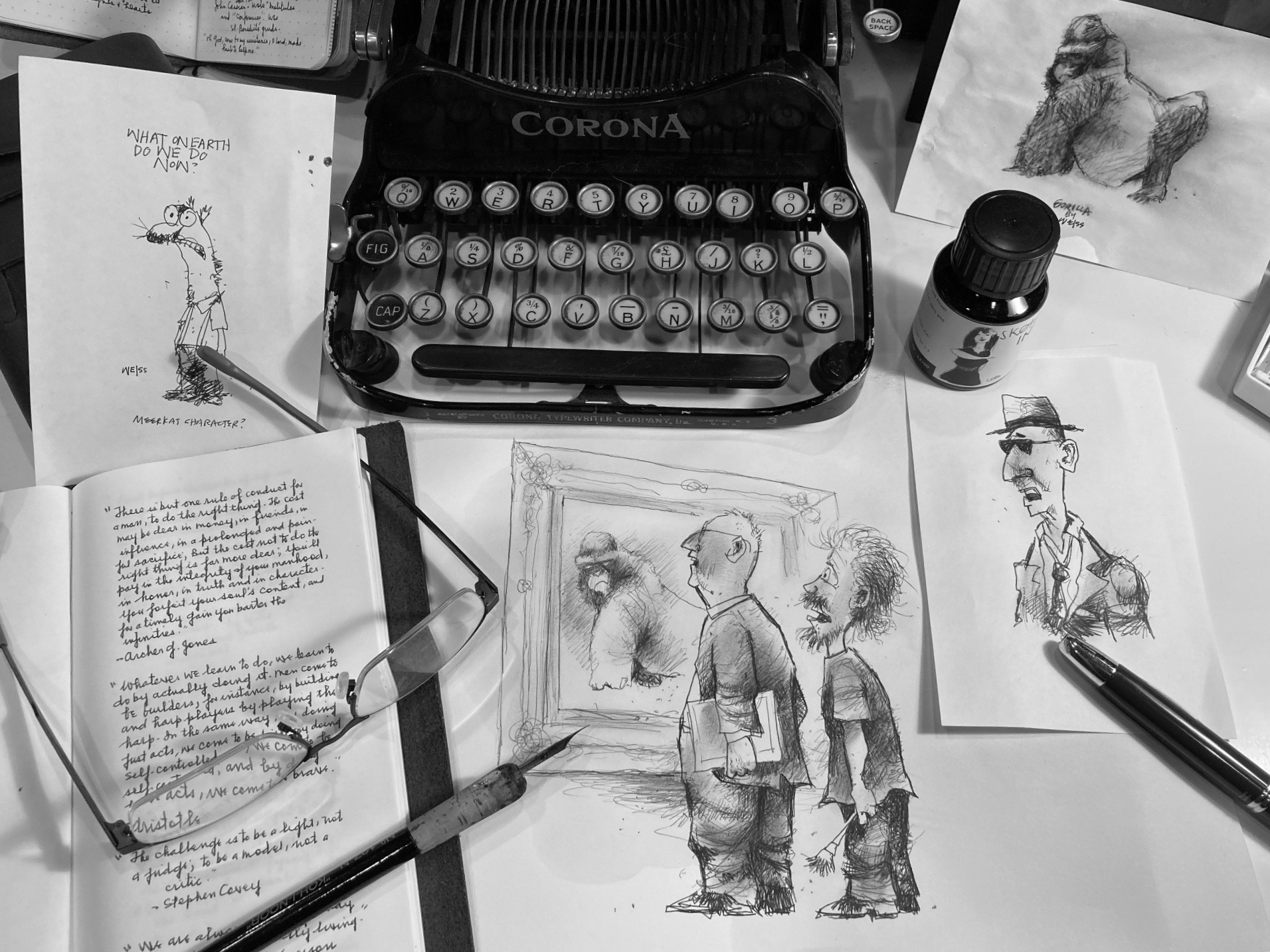
Notes and doodles on my writing desk
Pat Oliphant died last week at the age of ninety.
His obituary occupied only a small space inside The Wall Street Journal, easy enough to overlook. After reading it, I walked into my office and pulled several of his cartoon collections from the shelf. I spent the next hour turning pages, admiring the bold pen work, the razor-sharp wit, and Punk, the irreverent little penguin tucked into nearly every drawing.
Somewhere between those pages a question surfaced in my mind: What happens to the dreams we leave behind?
Mine were sitting only a few feet away, hidden in a cabinet. Old bottles of India ink. Worn pens. Brushes. Stacks of drawing paper. They'd been waiting there for years.
There was a time when they rarely gathered dust.
As a young police officer, I moonlighted as an editorial cartoonist for the Santa Cruz County Sentinel. Cartooning had been an obsession since high school and college, when I drew for the student newspapers with sketches inspired by Pulitzer Prize winners Jeff MacNelly and Pat Oliphant. Their intricate cross-hatching and fearless satire convinced me that editorial cartooning was as much art as journalism.
When the Sentinel invited readers to submit cartoons, I jumped at the chance. Before long my work was appearing regularly in the paper, and a dream began to take shape.
One afternoon I walked into the newspaper's newsroom with an idea.
The paper relied on syndicated cartoons covering national politics. Why not publish a weekly cartoon about local issues instead?
The managing editor liked the idea but couldn't promise anything. A few weeks later I was invited upstairs to meet with the editor.
"I like your work," he said. "Let's give it a try."
For the next several months my cartoons appeared each week.
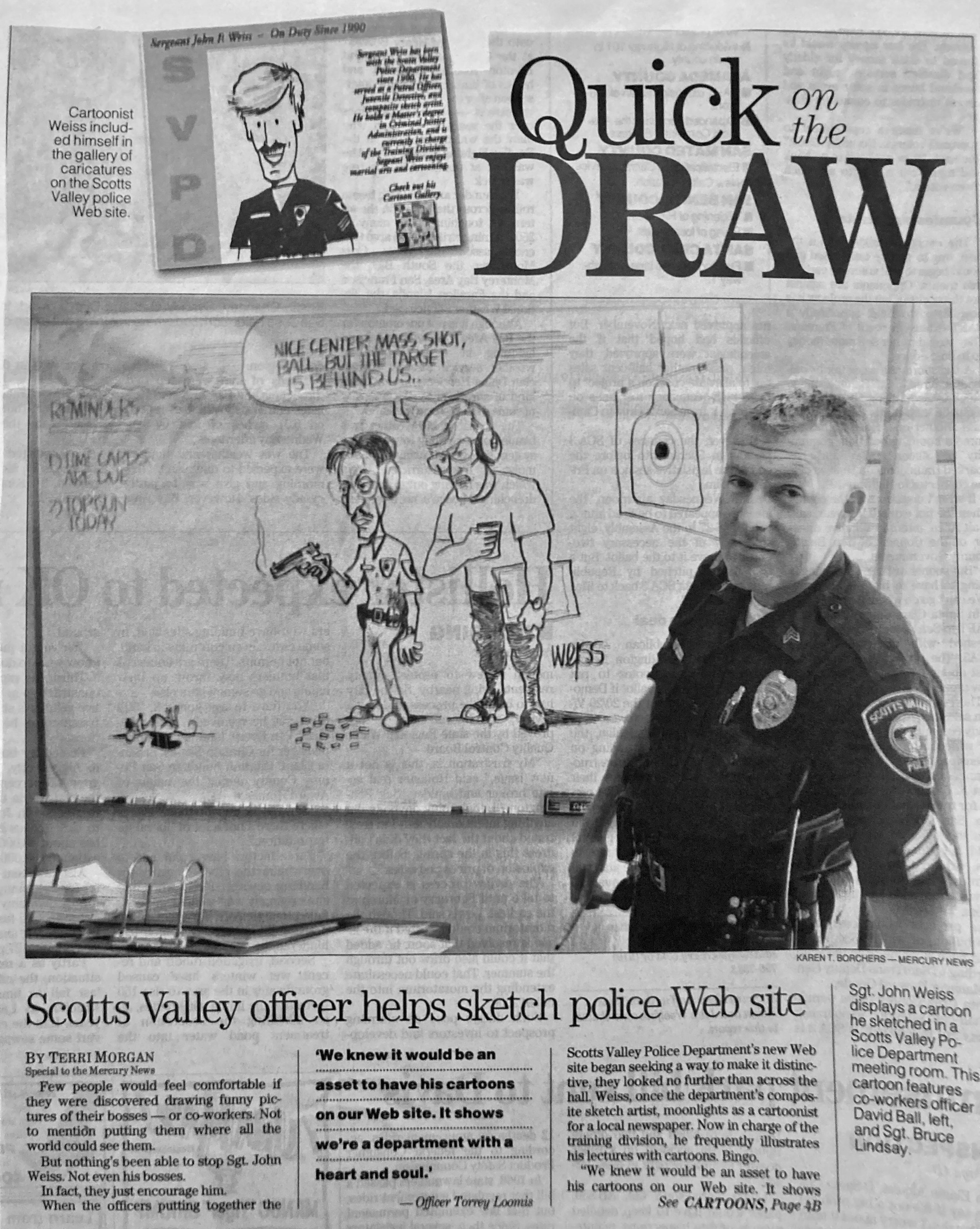
Cartooning cop media attention
Eventually I was invited to sit in on the newspaper's editorial board meetings. I listened as editors and reporters debated local controversies, scribbling ideas in the margins of my sketchbook. Sometimes I'd offer a rough drawing. Occasionally they'd build the editorial around it.
Even though I wasn't being paid, I felt like I was admitted into a world I'd admired from afar. For the first time, I wasn't just pretending to be an editorial cartoonist.
I was one.
My work improved.
I joined the American Association of Editorial Cartoonists and attended one of their national conventions. I even applied for a staff cartoonist position at a newspaper in New York. I didn't get the job, but for a while it seemed possible that cartooning might become more than a dream.
Then reality intervened.
My more controversial cartoons began generating phone calls. Not to the newspaper, but to the police department where I worked as a sergeant. Readers who disagreed with my cartoons complained to my chief. Others called to praise them.
Neither made him happy.
One afternoon he called me into his office. He reminded me of a cartoon I'd drawn criticizing the District Attorney's Office, another poking fun at a neighboring police department.
Then he looked at me and said something I've never forgotten.
"You're going to have to make a choice. You can have a police career, or you can have a newspaper cartooning career. But you can't have both."
At the time, I hated hearing it. I built up this fantasy of becoming a full-time editorial cartoonist.
But looking back, I think he saved me.
Editorial cartooning was already becoming an uncertain profession. Newspapers were shrinking. Staff cartoonists were disappearing. Had I managed to land one of those coveted jobs, there's a good chance I would have watched my profession slowly vanish beneath me.
Instead, I stayed in law enforcement.
Years later I became a police chief, retired with a pension, and gave my family the stability that career provided. At the time it felt like I was giving up one dream for another. Looking back, I realize life is rarely that simple.
Dreams don't always die, sometimes they simply step aside while something else asks for our attention.
Years after leaving the newspaper, I found a way to draw again.
I had begun writing essays online about life, work, and personal growth, and I started illustrating them with simple pen-and-ink cartoons. Because the essays weren't political, I no longer had to worry about angry phone calls reaching the police department.
Readers loved the combination, and the cartoons became part of my online identity. But over time something changed.
The essays that interested me most were becoming quieter, more reflective. I found myself reading less online and spending more time with novels, short stories, and literary essays. Writers like Kent Haruf, Claire Keegan, John McGahern, and Cormac McCarthy reminded me that good writing doesn't shout. It doesn’t lecture.
Good writing trusts the reader.
Gradually my own work began to change. I stopped chasing catchy headlines and easily digested life lessons. I became more interested in overlooked people, weathered sidewalks, forgotten cafés, and ordinary lives. I slowed down and noticed more of the quiet dignity hidden inside everyday life.
Ironically, as my writing became more personal, my audience became smaller.
Years earlier I'd hired a copywriting coach who taught me how to hook readers, write irresistible headlines, and keep people scrolling. The advice worked. But eventually I realized I no longer wanted to create work designed merely to capture attention.
I wanted to write work that lingered. Work that moved people. Work that resonated on a deeper level.
That choice cost me readers.
But it also brought me different ones. Readers who weren't looking for another productivity hack or motivational checklist. Readers who wanted stories that invited reflection instead of urgency.
Somewhere along the way, though, the cartoons quietly disappeared.
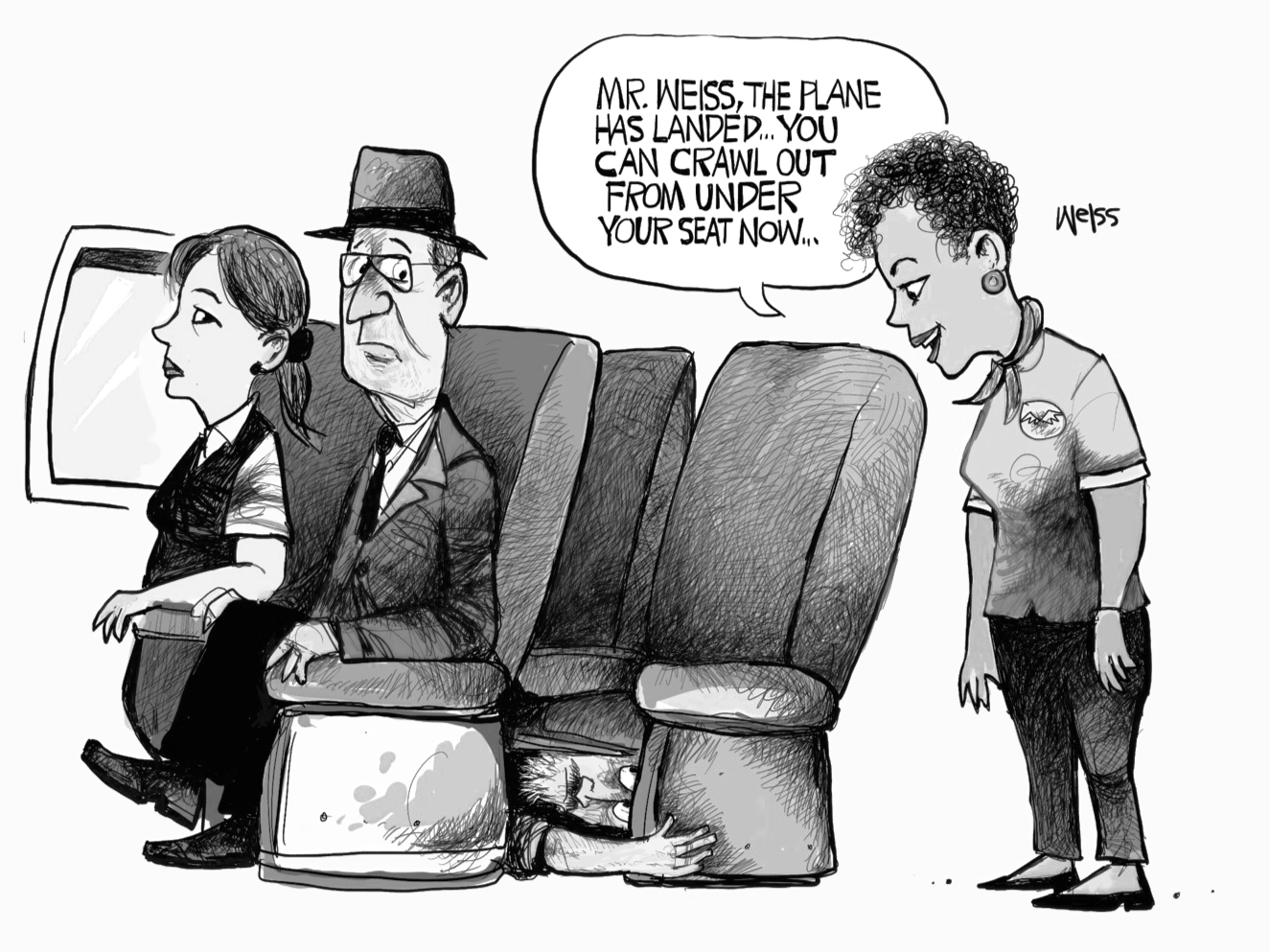
An old blog post cartoon of mine
At first I thought I'd simply outgrown them. Then I convinced myself they belonged to an earlier version of my life.
Serious literary writers, I reasoned, didn't draw cartoons. They focused on words, syntax, and elegant prose.
So, I packed away the pens, the brushes, and the ink.
I applied for and was accepted into the creative writing MFA program at the University of St. Thomas.
We read Henry James, Thomas Aquinas, Charles Dickens and books and essays about literary prose. The long hours of reading and classes prevented me from taking a trip back east with my wife.
She went by herself.
One night after a long class, I sat in the backyard flipping through my wife’s Facebook photos of her trip. I gazed at the beautiful fall colors and quaint towns.
I should have been there with her.
I thought of my busy police chief years. Sacrificed weekends and vacations because of work. I thought of my wife’s breast cancer journey. She remains cancer free, but the ordeal drove home the importance of sharing time with the ones you love.
And so I contacted my professor and left the MFA program.
Immediately afterward, my wife and I took a road trip to Monument Valley. Magical things happened on that trip, which I wrote about in the essay I Quit My MFA Program and Found a Spirit Dog in the Desert.
I realized that I don’t need an MFA to be a writer.
I already posses a graduate degree and a lifetime of law enforcement experiences to inspire several novels. All I need to do is keep reading great literature, keep noticing the world around me, and keep writing.
But what about my cartooning?
The Pat Oliphant obituary brought back memories. The thrill of seeing his work in newspapers and his cartoon collections in bookstores.
The other day my wife suggested renewing our subscription to The New Yorker. We had a subscription years ago but it lapsed when we moved. I remember all the literary stories, essays, and poetry in The New Yorker.
And I remember all the cartoons, too.
Why did I think cartoons were incompatible with literature? Why did I assume cartoons cheapen serious writing? With one simple suggestion, my wife set me straight. If there are cartoons in The New Yorker, there can be cartoons in Weiss Journal.
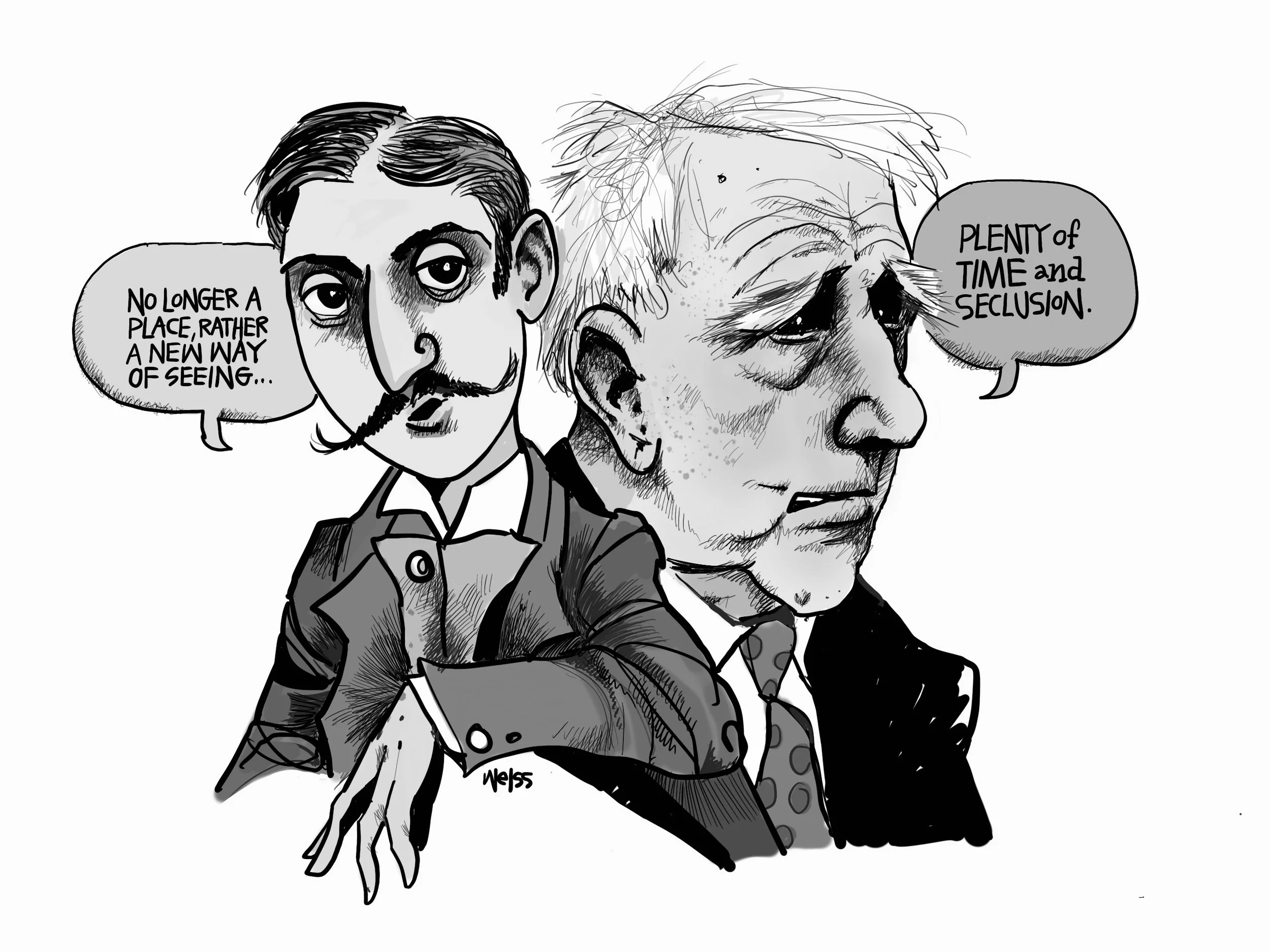
Old blog cartoon of Marcel Proust and Robert Frost
The dreams we leave behind sometimes wait for us.
I’ll renew our subscription to The New Yorker, and then I’ll crack open that cabinet in my office. The ink, pens, brushes, and paper have been hibernating long enough. Time to awaken the slumbering cartoonist.
I think it would make Pat Oliphant smile.