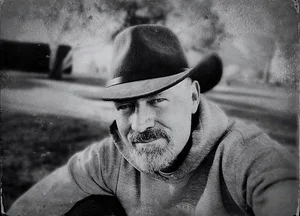
I Want Them to Notice and Remember
Photographs by John Patrick Weiss
There are mornings when words don’t come.
I flip through my journal pages, scanning the notes, quotes, and discursive ramblings, hoping that a promising thought or esoteric line might spark an idea. When that fails, I rise from my writing desk and venture into our home library to scan titles and run my fingers over frayed bindings. I pluck a favorite novel from the shelf and flip through pages, admiring the words and elegant prose. I sip my coffee.
But when nothing comes of these desperate rituals, I turn to my Alaskan Klee Kai, Nanuk, and slip on his leash.
“Let’s head to the park, buddy.”
He’s deaf but can read lips. I know because he wags his tail whenever I mention the park or dog biscuits.
The park is a short drive away, nestled below a middle school in a residential neighborhood. Here in drought-stricken Southern Nevada, we have plenty of desert landscaping. Ocotillo, lantana, yucca, agave, cacti, cloud sage, hopseed, various palm varieties, and lots of rocks. What we don’t have, apart from the golf courses, are enough lawns and trees.
Which is why Nanuk and I love the park, with its cool grass and rich canopy of velvet ash and Mondell pine trees.
I always bring my rangefinder-style camera, slung from a waist-length leather strap, just in case something interesting or beautifully obscure draws my attention.
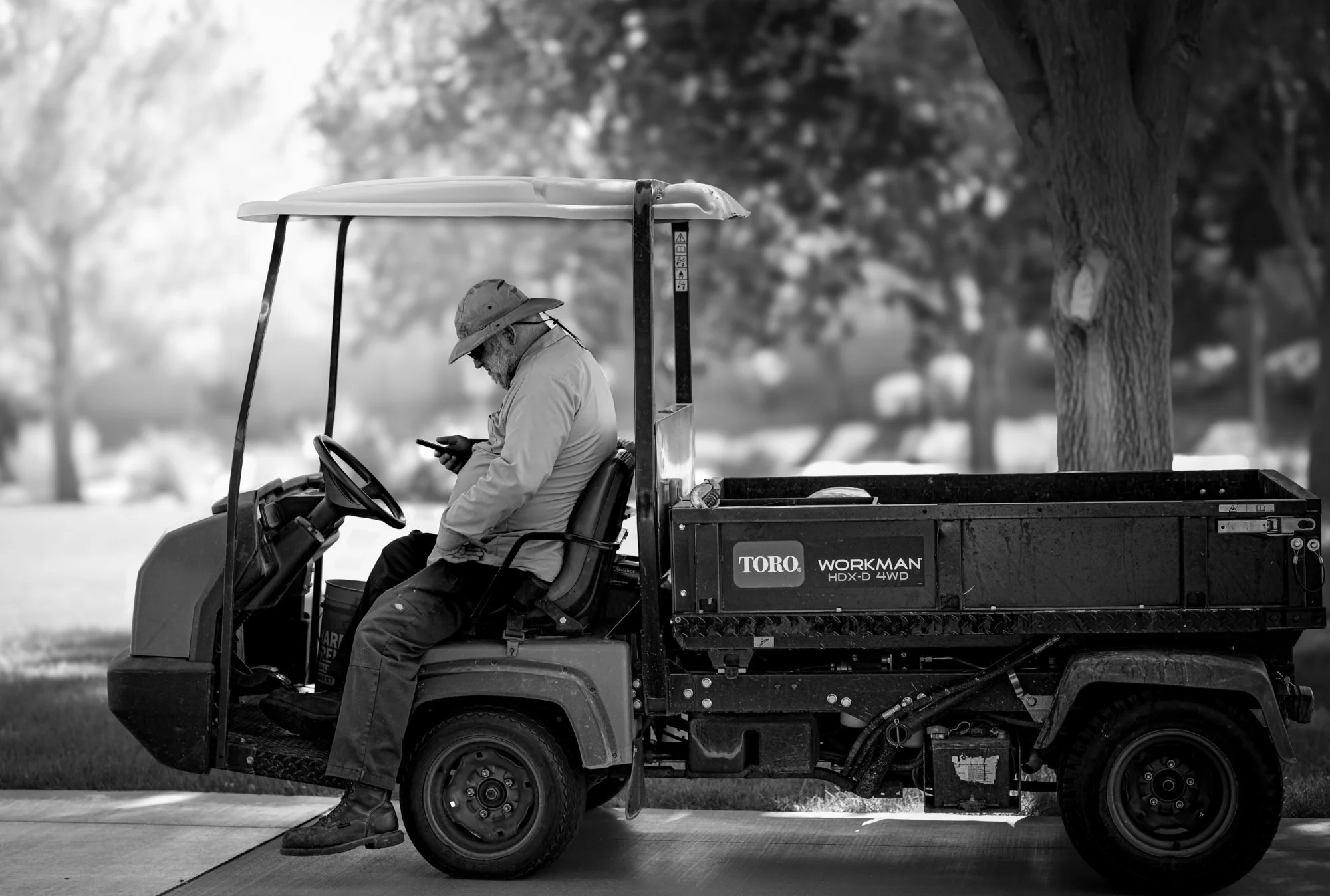
Which is what happened one early morning when we rounded the walkway and found a groundskeeper parked in his Toro Workman utility vehicle, lost in his smartphone.
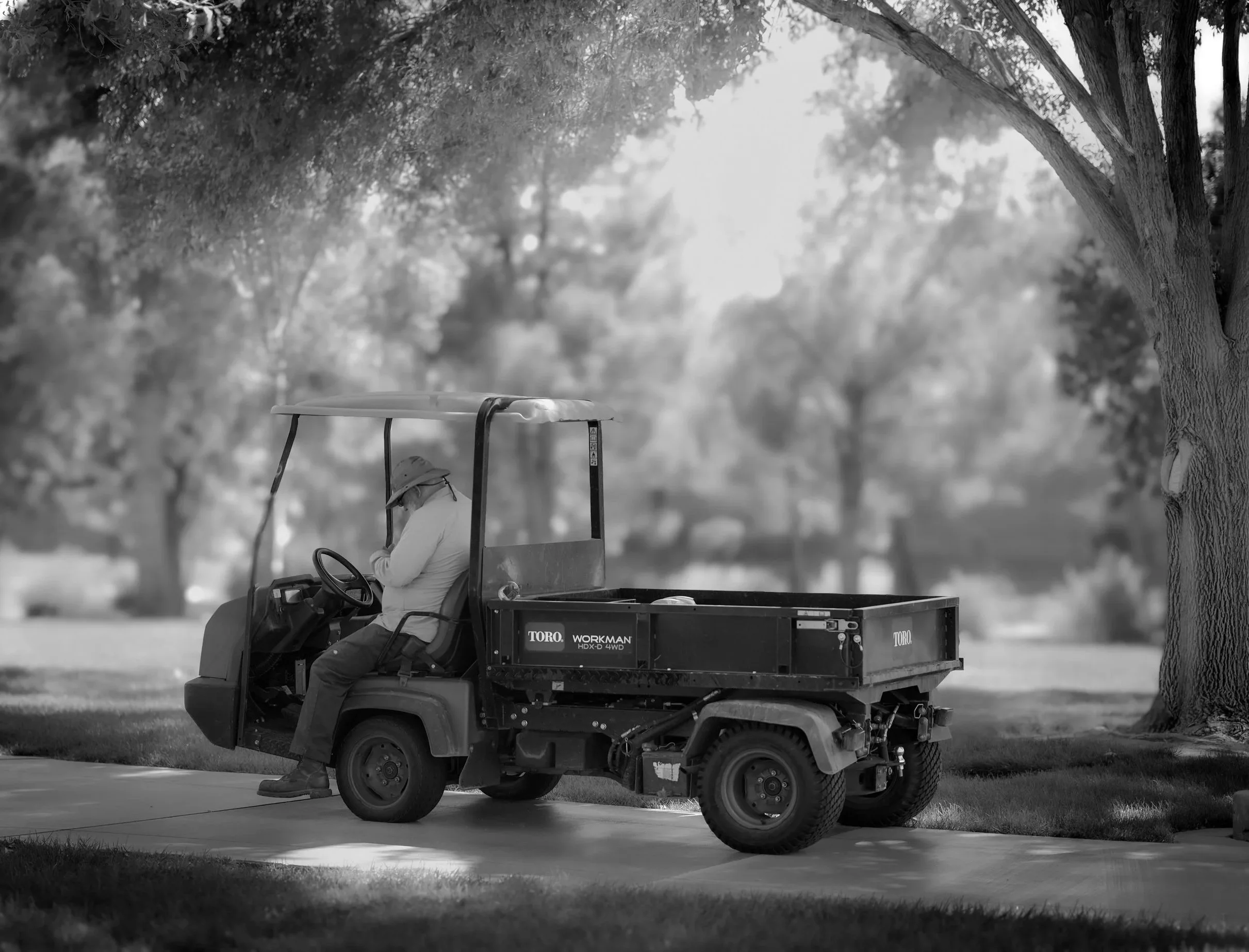
I was drawn to the morning light streaming down through the tree canopy, cascading in soft beams of diffused brilliance like divine radiance inside a cathedral. Grackles were chirping in the trees, and the slightest breeze danced through the leaves, grass, and shrubs.
I wondered if the groundskeeper noticed the magical light show. Had he already taken a moment to celebrate the serene beauty around him? Or were the distractions on his phone more appealing?
Many times when I visit the park, especially in the afternoons just after school gets out, I see kids glued to their smartphones. Sometimes they giggle and converse, but sooner or later they either coalesce around someone’s phone to watch TikTok videos, or scatter to their own corners and become privately subsumed in the online world.
The grackles watch them a little sadly, perhaps perplexed that nature’s charms are not enough to hold the children’s interest and imaginations.
I heard one kid in the park lament to a friend how his math teacher assigns too much homework, and my mind flew back to Harker Academy and my algebra class with Colonel Tuttle. The man once taught at West Point and must have grown bored in retirement, so he took up teaching at Harker Academy, to the enrichment of us all.
I used to sit mesmerized as he’d print on the chalkboard the definitions of various theorems, all in immaculate block letters. He’d draw maps of Europe and explain the origins of various mathematical laws and discoveries. There was an artfulness to his storytelling and use of those old chalkboards, and because of that I found algebra more interesting.
Walks with Nanuk in the park slow the jabbering thoughts in my mind, allowing disparate and often unconnected memories to float into my recollection like a breeze through an open window. Memories of tree houses and rope swings and watching the hands of the priest during the sacrament of the Eucharist on Sundays all remind me of the endless things I’d notice as a boy.
The laughter of my grandmothers. The way our poodle would bark at shadows and butterflies outside the windows. The warmth of my father’s immense hand cupped across my forehead when I was sick with strep throat.
So many big and little things in life to notice. So much to marvel at and question and celebrate.
Seems we did a lot of that in the youthful days of my generation. Sure, we had TV and music and magazines to distract us. But we still spent a lot of time outside, observing, exploring, noticing.
These days, more and more, it feels like we’re losing our ability to notice.
During my time in the University of St. Thomas MFA creative writing program, we read James Wood. His essay Serious Noticing, from the Fall 2010 issue of Michigan Quarterly Review, stayed with me.
He wrote about growing up in Durham, England, before moving to the United States in 1995. He recalled how every house had a hearth and fire and coal for domestic fuel. He wrote of the “dark, small men” who carried coal sacks on their backs, “with tough leather pads on their shoulders.” He remembered the ecclesiastical institution he attended as a boy, studying Latin and history and divinity and music. He wrote that it was so cold they used to dress in their beds. And the headmaster wore a black suit, buttonless shirt, and white clerical collar. He smoked a black pipe.
Wood noticed other things about the headmaster:
“He seemed to have been carbonized centuries ago, turned into ash, and when he lit his pipe, it seemed as if he were lighting himself. Like all children, we were fascinated by the match held over the pipe bowl, by the flame steadily journeying along the flimsy match, entranced by the sucking noises of the smoker and the way the flame halted its horizontal passage at these moments and then briefly disappeared vertically into the bowl; and always there was the question: how can he hold the match alight for so long, with such reptilian imperviousness?”
Wood went on to reminisce about an epileptic homeless man, “Tom,” that his mother sometimes helped. She’d prepare tea and sandwiches for the man in her kitchen. One time Tom fell into a seizure in the kitchen, “…his dirty hands twisting the dirty cloth of his trousers.”
Another detail was that Tom liked stamps, and would ask Wood to bring some home from school next time.
There would not be a next time.
Tom had another fit, perhaps at a campsite, and fell into the fire. The burns killed him.
Wood’s essay explores how literature makes us better noticers of aesthetic, human, and metaphysical things. Especially how metaphysical noticing can help us ask the deepest questions, rather than the superficial “unserious” noticing that takes up much of our lives.
Even back in 2010, Wood presaged where things were headed:
“Now we are an electronic mob, and the forces of distraction are powerfully arrayed against us.”
I wonder what Colonel Tuttle would make of today’s world, and whether his style of teaching would even capture the attention of the kids congregating after school in my little neighborhood park.
I wonder if he would gaze at them, and maybe even that distracted groundskeeper in the morning light, and feel concern. The perception that we’re losing our attention. Our patience with boredom. Our ability to notice.
My sense is that kids today still notice things. But maybe they’re different things. Perhaps they notice things that time and age have made me oblivious to?
I certainly hope so.
And I hope that some of them will channel their modern noticing into new works of fiction and great literature. Maybe one of those schoolgirls in the park will spot the chipmunks that scatter about the rocks along the edge of the playground. She’ll notice the brown and white stripes of the chipmunk’s coat, and this pattern and color will inform the fashion design for her 3D Roblox avatar on social media.
And maybe in her English class she’ll craft an essay about nature and fashion, connecting the utility of camouflage coloring in animals with how people camouflage themselves in the things they wear.
Now wouldn’t that be something?
James Wood thought about his own children in his essay Serious Noticing:
“Of course, I don’t want my children to have exactly the same childhood as I did: that would almost be a definition of conservatism. But I do long for them to be assaulted by the pungency, by the vivid strength and strangeness of detail, as I was as a child; and I want them to notice and remember. The carbonized clergyman; dressing in bed; Tom sitting by the kitchen drinking his sweet tea; the coal men with their leather jackets—you all have your equivalent memories. They are the foundation of our writing, because we need to notice in order to write good fiction and poetry, and then in turn the writing and reading of good fiction and poetry make us better noticers, better readers of the world.”
As I finish up my day in the park and entice Nanuk back to the car, I notice the school kids are on the move. They’ve gathered their backpacks and smartphones and dreams about the future as they head home.
The grackles join me in watching them leave.
A stunning cloud formation has gathered in the sky, and intermittent rays of light stream down on the soccer field below. I’d take a photo, but I know the highlights would be blown out. So I just take an extra moment to enjoy the splendor of it.
And then I see him, on a ridge past the playground.
He’s parked his utility vehicle and is standing with his back to me. No smartphone in sight. He’s using his right hand to shield his eyes a little as he stares up at the stunning cloud formation.
He’s nearly as still as a deer in the forest.
Motionless, lost in the noticing of the world’s eternal beauty.
My work is free. No paywalls or subscriptions. But if you'd like to buy me a coffee or donate any amount via secure PayPal, that would be wonderful.