Every Leaving Is a Loss and a Possibility
The only way to arrive is to learn how to leave
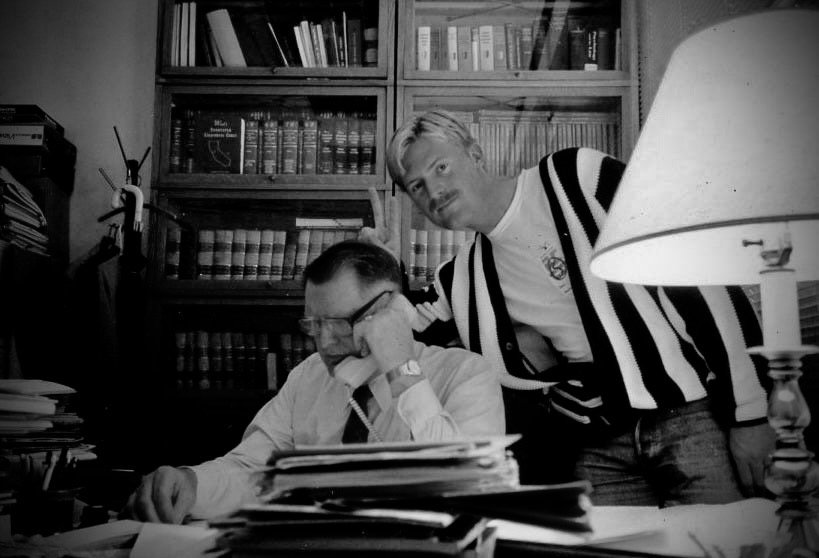
Visiting my father in his law office
He walked into my bedroom one summer afternoon and said, “Come on, Johnny, let’s take a drive to the cemetery.”
“The cemetery?” I was perplexed.
“Your mother’s down at the health club and I thought some fresh air would be good for both of us,” he said.
I just looked at him.
No one had died, and I was thinking about calling a buddy to have a beer in town. Because that’s what you do when you’re home from university for the summer. You meet a buddy at the pub. Maybe catch a movie.
You don’t hang out at the cemetery.
“I was thinking about going downtown to grab a beer with Steve,” I said.
Dad persisted.
“Let me get my wallet. We’ll go to the cemetery and afterward we’ll stop at the bakery and get one of those bear claws you like. You and Steve can meet up later.”
Dad knew I had a sweet tooth.
The cemetery didn’t sound appealing, but the bear claw was persuasive. I knew I could call Steve later.
I relented and agreed to join him.
Good fathers do more than love, protect, and provide for their children. They also teach them.
There’s a scene in Kent Nerburn’s timeless book Letters to My Son: A Father’s Wisdom on Manhood, Life, and Love that evokes echoes of my father and the many life lessons he taught me.
Kent’s father found a bicycle on the beach during one of his early-morning walks. The bicycle was a purple racer with hand brakes and a gearshift.
“It is the most beautiful bike I have ever seen,” Kent writes.
Kent’s father brought the bike home, placed a blanket over it in the garage, and advertised in the local papers for the owner. All the while, Kent secretly dreamt that the owner would never call.
But of course, the owner does call, and now Kent and his father are standing outside an apartment knocking on the door.
A man opens the door and the following unfolds:
“It has a lot of new scratches on it,” the man says.
My father says nothing.
The man turns the wheels, tests the handlebars. He looks at my father accusingly. I want to cry out that there are no new scratches, that it has been under a blanket in our garage. Instead, I look down. The bike glints and shines in the hallway gloom.
The man pulls it further inside and mutters, “I suppose I should give you something.” He pulls a crumpled bill and tosses it toward my father. My father gives it back.
The man glares at us and goes back to examining the bike.
We turn and walk down the hall. I grab my father’s shirt. “Why were you so nice to that man?” I ask. “He was really mean.”
My father keeps walking. “Maybe he’ll pass it along someday,” he says.
Kent Nerburn’s story calls up a boyhood bicycle memory of my own.
I was outside our garage, fidgeting with a loose bolt on my Schwinn bicycle. I was in a foul mood.
Dad joined me and sat down on my bicycle seat. He told me to grab a wrench in the garage. When I returned my mother came outside and took a photo of Dad, because his large frame looked ridiculous straddling a boy’s bicycle.
Dad sensed I was upset about something.
“It’s just a loose bolt, Johnny, we’ll have it fixed in no time.”
“It’s not that,” I said.
“Then what’s the matter?”
I told him how my best friend didn’t invite me to his birthday. How he invited another friend to go to some carnival, and that I was never going to invite him to any more of my birthdays.
Dad was quiet a moment, which drew my attention.
“That would be a mistake,” he said.
He added that perhaps my buddy could only afford to bring one friend to the carnival. And that excluding my friend from my birthdays was wrong.
“Never take the low road, Johnny,” he said. “When you do the right thing, you pass it on to others. It might rub off on them, it might not. Either way, that’s what a good man does. That’s what strong character is about.”
He hugged me and we finished fixing my bike.
Madronia Cemetery is nestled in the foothills above the village of Saratoga, California. It is the town’s oldest institution, dating back to 1854.
It is a private cemetery.
Only local residents and family members can be buried there among the exotic trees, well-maintained grounds, and sun-dappled serenity. My maternal grandparents and aunt are buried there. So is the famous “painter of light” Thomas Kinkade.
My father parked his beloved 1964 Valiant near the cemetery business office.
I follow my father as we stroll the grounds. Squirrels scurry past us between rows of gravestones and expansive lawns. The warmth of the summer sun is tempered by a cool breeze dancing through the canopy of oak trees.
“Look at all those headstones, Johnny. Each one is a story about love, loss, life, and death,” Dad said in a reflective tone. “Everyone avoids this place. Too busy chasing careers and dreams. But Father Time always wins.”
We arrive where my grandparents are buried.
The breeze recedes and everything feels peaceful and still. I close my eyes, remembering grandmother’s Irish soda bread. She’d bake it fresh, pull it out of the oven, and serve it with loads of butter.
“A fine feed,” she’d say in that sweet Irish lilt, and my father would retort, “Good Lord, Mary, we’re not cattle!”
After we paid our respects, I walked with Dad to the cemetery office.
“I’m going to purchase a plot for myself. Don’t want your mother having to navigate all this someday. Especially the upselling and expenses,” he said.
Dad had no illusions about mortality.
When I was 13 years old, Dad suffered a heart attack in front of me at home. Mom came running from the kitchen and told me, “Johnny, sit with your father! Hold his hand!” And then she ran to call 9-1-1. The paramedics arrived in a flurry of action and whisked him away to the emergency room.
The trauma of that day never left me.
Even now, I can’t relax when a physician or nurse checks my blood pressure. The diastolic always rises and I have to explain that I’m not hypertensive, just emotionally wounded.
A kind of cardiac post-traumatic stress disorder.
Many years later, when Dad’s medication no longer worked, I drove him to the hospital for bypass surgery. He looked terrible afterward in recovery, all puffed up and bundled with warm towels to alleviate his shivering. But he managed to open his eyes and gaze at me.
I told him he looked great.
That day in the cemetery, Dad bought his grave plot and reminded me that the receipt would be in the file that contained his last will and testament. He was an administrative law judge and had written his own last wishes.
Madronia Cemetery where my father is at rest.
As we got in the car to leave, Dad looked out at the quiet cemetery. Water from a nearby fountain trickled in a soothing, hypnotic rhythm.
“The only way to arrive, Johnny, is to learn how to leave,” he said.
Years later, I encountered a line in Kent Nerburn's Letters to My Son that brought me back to that day in the cemetery: "Every leaving is both a loss and a possibility."
Leaving a relationship, a home, a job, or a particular stage of life naturally carries some measure of grief and loss. We leave familiarity and comfort.
We mourn the end of the person we were.
But leaving also clears the path for the unknown. And that’s where true growth and discovery live. Leaving opens us to new encounters, fresh lessons, and opportunities to re-examine who we are now, or who we are becoming.
That day in the cemetery, I didn’t understand what my father meant when he said that the only way to arrive is to learn how to leave.
But I understand it now.
Dad adjourned to the heavens on Sunday, January 18, 2004. He was 82 years old.
He retired from the bench at the age of 79. But cruelly, his retirement was short. His health deteriorated and the atherosclerosis that had caused his heart problems was also responsible for a vascular form of dementia.
Then he went into renal failure.
I remember holding his hands that last day. Telling him that if he was tired, to sleep. That we were all fine. That he didn’t have to worry about us. That we loved him.
It was getting late that Sunday evening and I had to get home. An hour after I left the hospice nurse phoned to tell me my father passed away. And so I drove to my mother’s house to deliver the sad news and she cried and cried in my arms.
I made all the arrangements for my father’s memorial.
My mother had always relied on Dad to handle everything, and so I stepped in now. The son had become the father.
Dad had left, but in doing so, I had arrived into a new version of myself. I already had a little boy of my own, but this new version of myself was something more than fatherhood.
I was becoming wiser, more capable, more sure of who I was and what it meant to be a good man.
“You’re so much like your father,” my mother said after I officiated at my father’s memorial. I hugged her and we drove to the reception. It was a long day. Thanking people, handling all the logistics.
After it was all over, my wife drove my mother and son home while I packed up the last of the photos and display items we’d set up at the memorial. I got into my car and slid the last box of items toward the front passenger seat.
A photo slipped out of an envelope and fluttered gently down to the floorboard.
I bent over, picked up the photo, and turned it over. It was the photograph my mother had taken a lifetime ago.
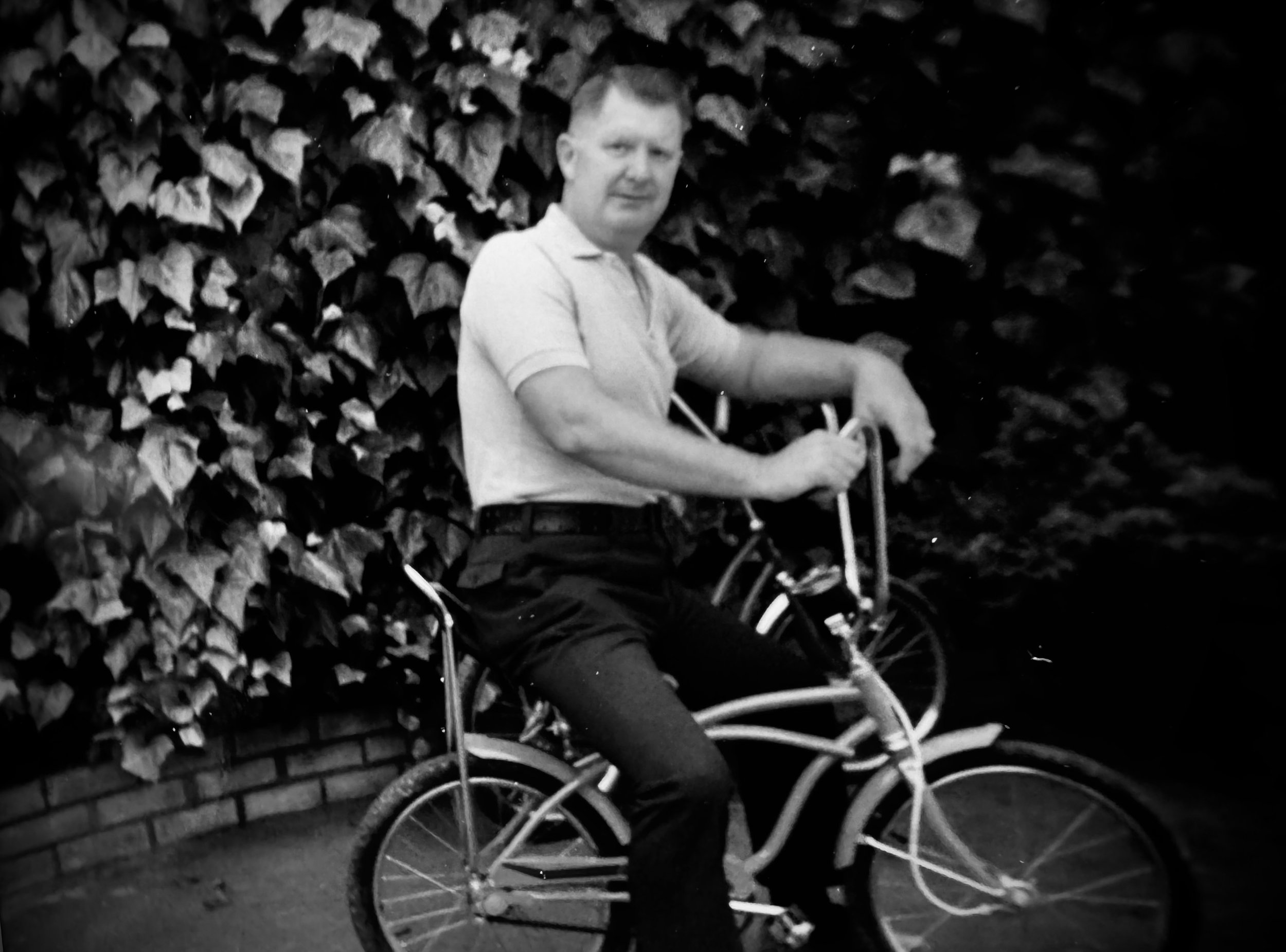
That day outside the garage.
That day my father helped me fix my bicycle. That day he taught me about never taking the low road, and what it means to be a good man.
That beautiful day has resided in my heart all these years.
I wept in my car for a long time.