This Once Mattered
A vestige of something refined and elegant
Photograph by John Patrick Weiss
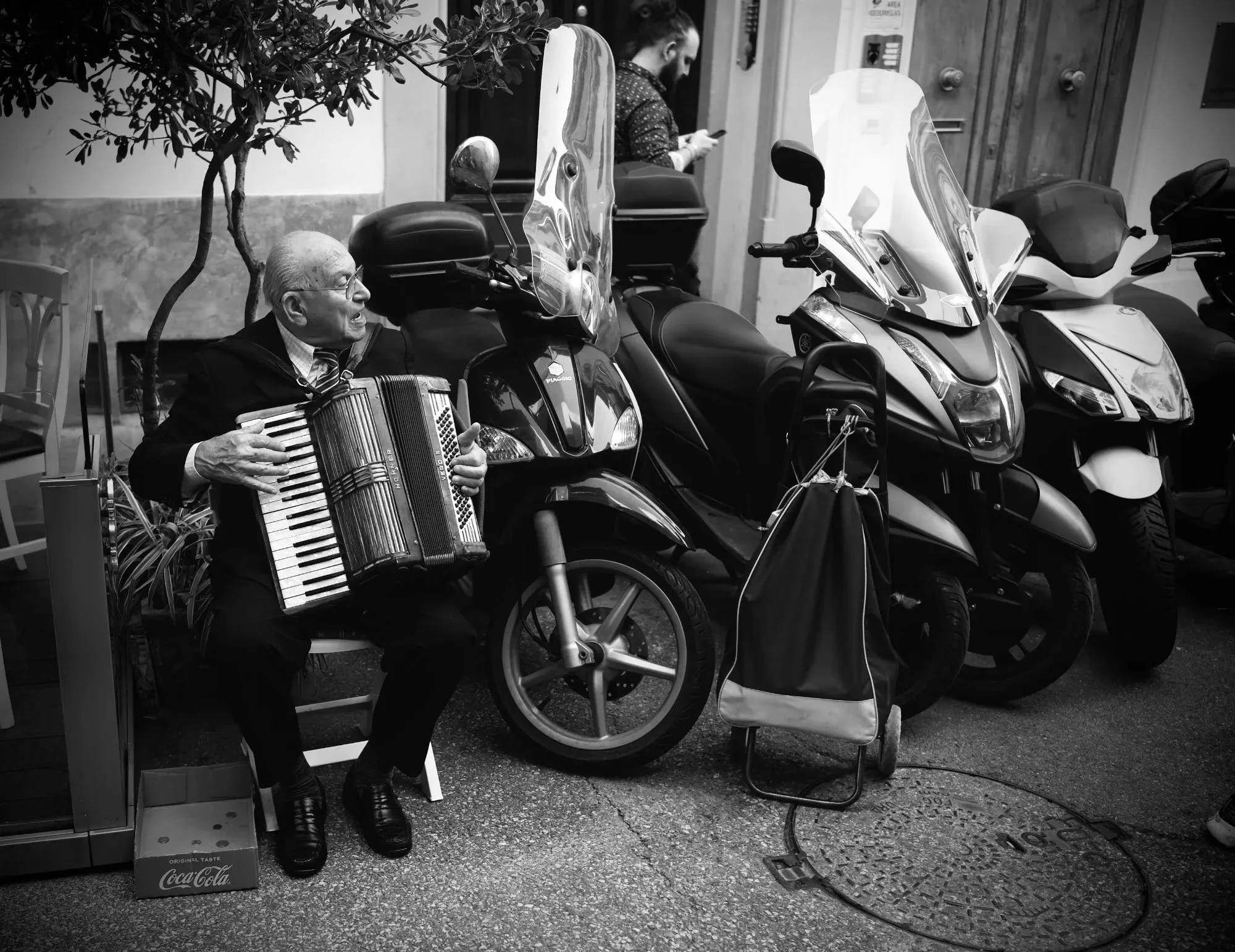
There was a man singing with an accordion in Italy.
I was walking the sampietrini cobblestones when I came upon him, an aging busker serenading tourists and shopkeepers with a smooth tenor and upbeat melodies. He was dressed smartly in a jacket, crisp white shirt, necktie, and polished shoes. A cardboard Coca-Cola box, nearly empty save a few coins, sat on the ground beside him. Nearby rested a slender handcart and bag for transporting his accordion and folding chair.
He looked like a man from another time. A vestige of something refined and elegant, largely forgotten.
Tourists in shorts, tee-shirts, and flip-flops passed by without much notice. Most were peering into shop windows, taking selfies, or staring into their phones for directions. One woman giggled, tossed a coin into the box, and disappeared into a souvenir shop.
I felt sorry for the old fellow.
He was boxed in by a row of shiny motorbikes and scooters. A shopkeeper behind him stood absorbed in his phone, indifferent to the music and the lyrics. The man played on.
I raised my camera and took the photograph.
Days later, on the flight home, I scrolled through my images and stopped on the accordionist. His elegant suit. His polished shoes. His Hohner Verdi accordion. His folding chair and humble tip box. A man outnumbered by modern machines, ignored by shopkeepers and tourists, yet still performing.
Still chasing the dream, like Santiago and his marlin.
Except the old accordionist’s foe is not a shark. It is modernity.
This year I sent out sixty personalized Christmas cards.
I have fond memories of my father filling out Christmas cards at the kitchen table, addressing envelopes with his Parker 21 fountain pen. He always wrote a short note inside each card. I loved the mail that time of year. Colorful envelopes. Interesting stamps. Distinctive handwriting from family and friends. Each card felt like a small act of attention.
Of the sixty cards I sent, only a handful were reciprocated.
A few people sent holiday greetings through social media. Thoughtful, perhaps, but unmemorable. I do not print out digital messages and place them in the small Christmas card sled that sits on our hallway bureau. Digital messages are ubiquitous and require minimal effort beyond typing a few words. They carry little of the sender’s humanity. No handwriting. No tangible presence.
More and more, it seems people are cutting the thread.
Severing the strands that once bound them to history, friendships, and neighbors who once mattered but have drifted with time and distance. I do not know if this drift is benevolent or intentional. Perhaps some conclude that if you no longer live nearby, it is time to let go. Focus on those close at hand. Focus on the new.
Why invest in the past.
My son came home for Christmas, and I asked whether he planned to see a friend from his ROTC detachment.
“No,” he said. “He doesn’t reply to my messages anymore.” There had been no argument between them. No falling out. Just silence. The friend remains active on social media, despite no longer replying to my son.
Ghosting has become ordinary.
Which is strange, given our era of constant presence. Texts. Updates. Images. Proof of life offered every twenty-four hours. Photos of lunch. Photos of pets. Photos of workouts. Documenting the obvious and the unremarkable.
The tyranny of show me.
Yet people think nothing of cutting the thread. Dropping old friends because of distance, inconvenience, or quiet disinterest. And it is not only the young.
I have a childhood friend. Our families spent holidays together for years. I attended her wedding and got to know her husband. Eventually they moved out of state.
Each year I send a Christmas card with a note and return address. This year I added my email and wrote, “How are you doing? I would love to hear from you.”
Nothing.
Maybe there is a new social contract and I missed the memo.
Maybe Christmas cards, letters, and the effort of staying tethered to one’s past are now disposable. Perhaps busy lives excuse us from even trying.
Yet we still find time to scroll. To comment. To post. To react.
Some will argue that digital communication is more efficient, less wasteful, and more practical than cards and letters. Maybe they are right.
Maybe I am an anachronism. Maybe I am romanticizing the past.
Or maybe I simply refuse to cut the thread.
Letters and cards take time. That is the point. They require effort. They carry voice and presence. They become objects that can be kept in a shoebox and rediscovered years later, like perfumed letters from college sweethearts or a father’s handwritten advice.
This once mattered. Maybe it still should.
I wondered whether I should stop sending Christmas cards. Whether I should retreat into a small circle of immediate family and nearby friends. Whether I should ghost everyone else.
But the idea left a bad taste in my mouth.
I may refuse to participate in the exhausting modern maintenance of online presence, with its superficial digital ephemera. But I will continue to write my letters and send my cards, even if they go unanswered.
I do it because this once mattered. Because attention, time, and effort are not inefficiencies. They are signals that we still care.
You are telling someone they still matter. That you remember. That you will not abandon the friendship, the history, or the shared past.
You are saying you will not cut the thread.