They Came Through the Woods
Kindness is a colour in the wind
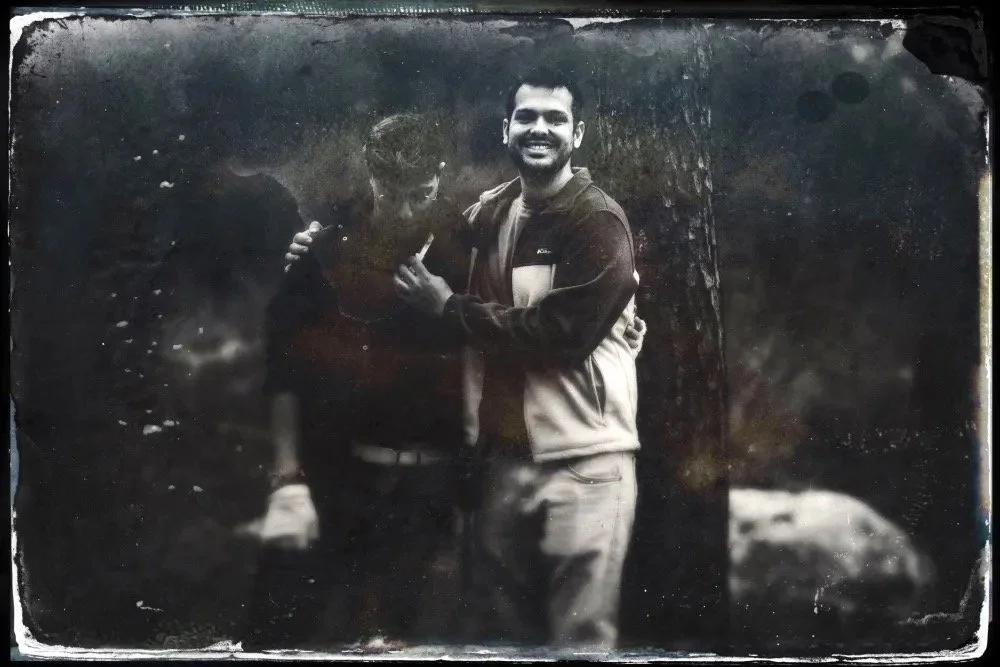
Photo by BehindTheTmuna (post production by John Patrick Weiss)
They came through the woods after a light September rain.
Branches cracked beneath their shoes despite the moisture, and their laughter echoed past oak trunks and deer trails, echoing a kind of joy found more in children than in grown men.
It was Saturday.
I followed my father down the steep driveway to the mailbox nestled in ivy at the edge of a low brick wall, painted white and furred with soft lichen.
Dad sorted the bills, a few letters. We started back up the driveway, and I scrambled to keep pace. Ten-year-old boys do that. Follow their fathers around. Try to keep up. Try to be like them.
We reached the parking spot twenty feet below our front door when my father stopped.
“You hear that?” he said.
I looked up, confused, but then I heard it too: laughter and rustling brush just beyond the tree line.
A faint smile touched my father’s face.
“Greg? That you?”
The woods answered with movement. Two young men stepped from the trees, damp and leaf-speckled.
“Hi John!” the taller one said, hand extended.
“Hello Greg, how are you?” Dad said.
“I’m fine, John. This is Doug. He’s my friend. We go to school together.”
Doug wiped his nose with a fingerless mitten. “Hi John. I’m Doug, but my mom calls me Duggy. Sometimes she calls me Huggy Duggy.”
“Huggy Duggy, Huggy Duggy!” Greg cried, bursting into laughter. The two of them collapsed in giggles.
To a ten-year-old boy, it was strange. Grown men acting like boys.
Dad didn’t seem surprised. “Would you two like some Coke and cookies?”
“Yes, John! Come on, Huggy Duggy, let’s have a snack!”
Doug grinned wide. “Let’s have a snack! Let’s have a snack!”
I looked at my father, puzzled. But he just patted my back. “Come on, Johnny. Let’s get these men some refreshment before their long hike home.”
Inside, Dad brought out the Cokes and cookies. We sat on the front patio, the sun emerging from behind retreating clouds. The wet-earth scent of petrichor filled the air.
Greg and Doug told stories about salamanders and poison ivy, cartoons and TV shows. My father laughed with them. I watched.
Greg climbed the retaining wall and declared: “They can rebuild him. They can make him better than he was before!”
Doug chimed in. “Better! Stronger! Faster!”
Then Greg leapt theatrically to the lawn. Doug clapped and announced that The Six-Million-Dollar Man was his favorite show.
I glanced at my father. His eyes were calm. There was no judgment in them. Only warmth.
I laughed too.
We sat in the late sun, sipped our sodas, nibbled cookies, and shared the strange magic of that afternoon. Eventually my father checked his watch.
“Greg, do you think you should be getting back home? Your mom might be worried. I can drive you both.”
“Oh, yeah,” Greg said. “You’re right, John.”
We piled into the 1968 Valiant. Dad didn’t need directions—Greg had been here before. At their house, my father opened the car door for them. Greg hugged him. Doug shook his hand.
“Thank you, John,” they said.
They walked off arm in arm. Greg’s mother waved from the doorway. My father waved back. Then we drove home.
“They’re special, Johnny,” he said at last. “All they want is to be treated with kindness and dignity.”
I repeated the words. “Kindness and dignity.”
I had forgotten Greg, until Dickens brought him back to me.
In my MFA program, one of the assignments was Little Dorrit, that late, great novel of prisons and pride.
Amy Dorrit was born inside a debtor’s prison, raised in poverty and shadow. Yet somehow, she shines.
Victorian London is not so different from our own world. There is cruelty. Pretension. Narcissism. Systems built to serve themselves, like the “Circumlocution Office.”Dickens knew that a person could be imprisoned long before chains touched their wrists.
But Amy Dorrit is free.
Her friendship with Maggy, who, due to childhood illness, never matured past ten, reminded me of Greg and Doug. And Amy’s kindness toward Maggy reminded me of my father’s kindness.
Amy tends to Maggy with grace and patience, not obligation. Her goodness flows outward, quietly, unstoppably.
This is what my father taught me in the gentle and kind way he interacted with Greg and his friend.
I remember Melinda, a developmentally delayed girl from my grade school. Her parents couldn’t pick her up one day. My father offered to drive her home. When we got there, he said I should walk her to the door.
“Like a gentleman,” he said.
I remember my sister volunteering at a home for disabled children. How unpretentious they were. How sweet. And the way my sister interacted with them, with patience and love.
It was moving.
And I remember during my law enforcement career the Special Olympics. Medals we’d give the athletes. Smiles that always warmed my heart.
All these memories stirred to life by the same deep current: a love without calculation.
There is a quote, often tied to Dickens:
“No one is useless in this world who lightens the burdens of another.”
We live in a loud, fast world. Much of it engineered for cruelty. On social media, vanity metastasizes. And some spend their whole lives in pursuit of fame, only to realize too late that they’ve spent themselves badly.
They forget what matters. They forgot kindness, the thing that makes us human.
“Kindness is a colour in the wind,
formless yet ever-present,
shaping itself in all it touches.”—Bhuwan Thapaliya
Dickens warned us of moral imprisonment. That warning still stands. And if you look closely, you’ll see it. Not in prisons, but in the eyes of those who have traded decency for self.
But there are always lights.
Amy Dorrit, who loved freely. My father, who gave Greg and Doug Cokes and cookies, and treated them like men. The ride he gave Melinda. The special kids my sister volunteered for. The medals uniformed police officers present to special athletes.
These are small things. Holy things.
The kind that can save us.