The Case for the Unoptimized Life
Creation is an act of self-rescue
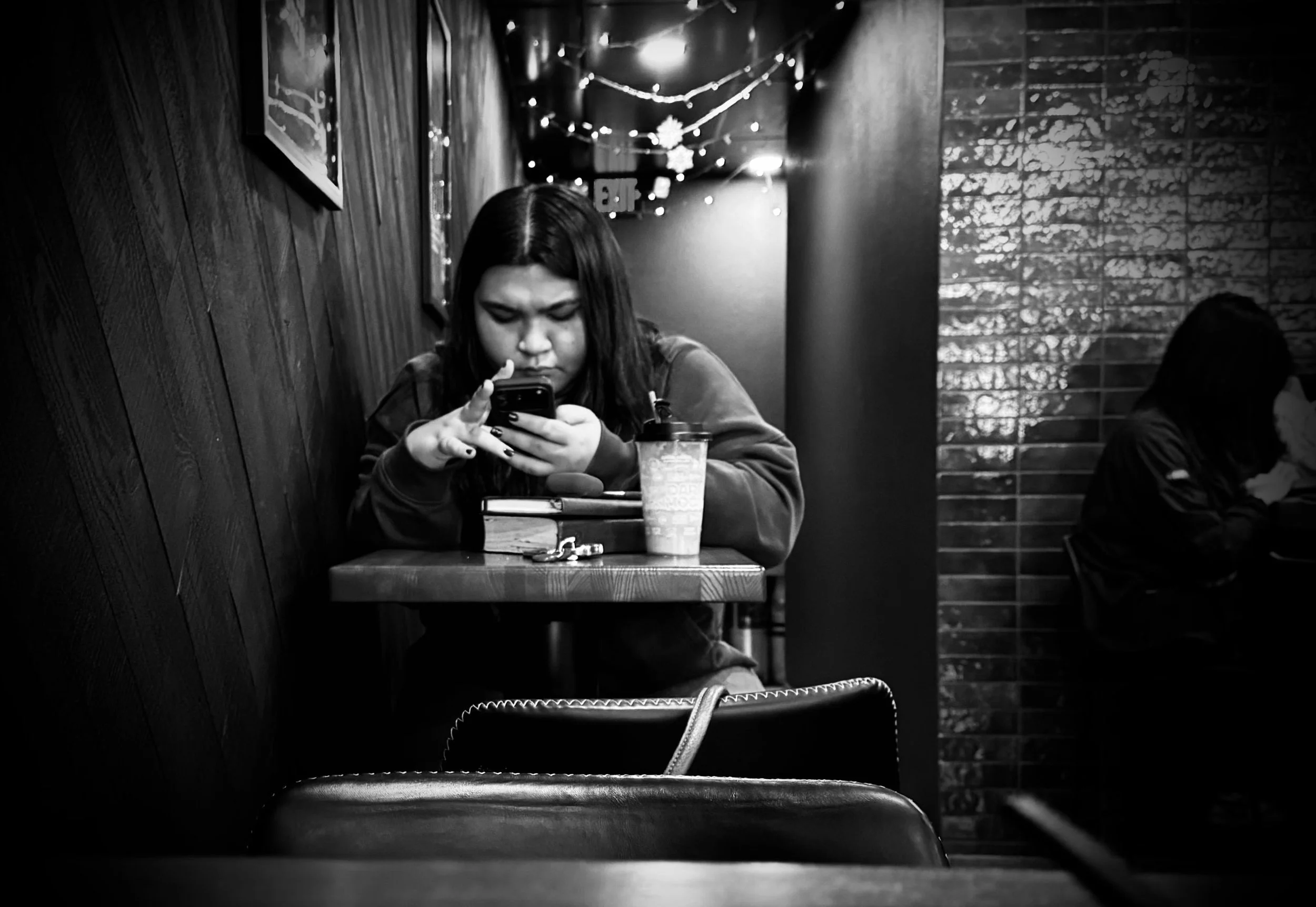
Photo by John Patrick Weiss
I was in a coffee shop with a friend. We sat at a small table with our cups between us and spoke of ordinary things. His swimming workouts. Gatherings with friends. The coming holidays. Nothing pressing. Nothing urgent.
We listened. We answered. Our phones stayed in our pockets. The coffee cooled.
Time moved in an unhurried way.
Behind me a woman sat alone at another table. She held her phone in both hands and scrolled. I left for the men’s room and came back and she had not looked up. When my friend and I stood to leave I glanced over my shoulder.
She was still there. Still scrolling.
I get it.
People sitting alone often turn to their phones. It fills the space. But there was something quietly sad about it.
People once brought books to read with their coffee. She had them with her, unopened. People used to look up and take in the room. Sometimes eyes would meet. Sometimes kind words would pass between strangers. Coffee. Work. Life.
And now and then that brief exchange would widen into something lasting. Lifelong friendships. Marriages. Years later they might recall the afternoon when they first spoke. The coffee shop. The ordinary hour. How they decided to linger over a second cup and how they are still lingering twenty years later. Maybe their children know the story about the coffee shop.
All because Mom looked up.
I have not stopped thinking about that scene because it feels like a true picture of the moment we are living in. We are surrounded by distraction and fed without end. We are entertained. We are occupied. And yet something essential is thinning. Not information or convenience but attention and presence.
The slow pleasure of being human with one another.
The same thinning has entered our creative lives. Machines now produce sentences that pass for writing and images that pass for seeing. For many writers and artists a question has begun to surface.
What’s the point?
Why labor over words or wait for the right light when the world seems satisfied with faster substitutions. Why pour out your soul or burn the candle perfecting your artwork. It can begin to feel pointless in a world consumed by trivial videos and endless distractions.
Yet I do not feel that way. I feel the opposite.
I believe this is the moment when making things matters most.
There is a writer named Paul Kingsnorth who has spent much of his life pushing back against what he calls the machine.
He began as an environmental activist and grew disillusioned, not only with politics but with the deeper story modern life tells itself. The story of endless progress. Endless growth. Endless solutions.
Over time his resistance widened. It was not only the destruction of the natural world that troubled him but the way technology reshapes how we see, how we live, how we understand what it means to be human.
Kingsnorth does not argue for abandoning tools or retreating from the world. His concern runs deeper than that. It is about what happens when efficiency becomes our highest good. When speed replaces depth. When convenience replaces meaning. When the machine begins to tell us who we are.
I think he is onto something.
When everything is smooth, people begin to crave texture. When everything is optimized, they begin to hunger for soul. When everything is abundant, meaning becomes rare.
We are surrounded by content and starving for substance. We are flooded with images and aching for something that bears the mark of a living hand.
People will become hungry for work that smells like a person made it. Not perfect. Not optimized. Not algorithmic. Human.
Creation, at its core, is an act of self-rescue.
A way of paying attention. A way of staying awake in a world designed to lull us into passivity. It is a way of saying I was here. I noticed. I lived inside this body and this hour and tried to give it shape.
If you feel called to make something, make it. Even if it does not sell. Even if no one notices. Especially now.
Sharing comes second. Applause comes last, or not at all. And that has to be enough.
This way of thinking has shaped how I try to live.
It is why I am drawn to minimalism and simplicity. Why I keep shaving away the extraneous and unnecessary. Not out of austerity but out of care. I want fewer distractions between myself and the people I love. Between myself and the work I feel called to do. Writing. Photography. Noticing the world and responding to it.
I am not interested in winning a race against machines. I am interested in remaining human, and in honoring the mysterious source from which our making comes.
Optimization promises ease, but it exacts a cost.
It trains us to value speed over depth, output over meaning, convenience over care. It rewards what can be measured and ignores what cannot. Attention can be captured at scale. Depth cannot. Presence cannot be automated.
Love resists efficiency.
An optimized life leaves little room for silence, for boredom, for the patience required to notice anything worth noticing. It fills every pause. It crowds out the interior life. And when that life begins to thin, so does our capacity to make anything honest or true.
The unoptimized life is not inefficient by accident. It is inefficient by choice. It lingers. It waits. It accepts friction. It leaves space for conversation, for reading, for walking without purpose, for making things slowly and often imperfectly.
It makes room for the human.
I try to live this way where I can. I simplify. I remove what distracts.
I choose fewer tools and deeper attention. I spend my time with people I love. I write sentences slowly. I walk the streets with a camera and wait.
I am not interested in keeping up.
I am interested in noticing. In bearing witness. In making something small and honest out of the hours I am given. I do not claim to have all the answers, and I am not opposed to using technology where it genuinely serves us, so long as we do not lose our humanity, flaws and all.
I am not interested in winning a race against machines. I am interested in remaining human, and in honoring the mysterious source from which our making comes.
Do not give up. Do not believe there is no point, because there is.
The world does not need more derivative content or frictionless perfection. It does not need prose polished into lifelessness or images scrubbed of human presence. It needs work that bears the marks of its maker.
What the world wants, what we all deserve, is the perfection of human imperfection.
Pay attention. Make something honest. Leave behind a trace of having been here. In a world rushing toward efficiency, choose presence. In a culture chasing perfection, choose the human.
That’s where the life is.