Slowing Down to Find the Person We Forgot
An invisible monastery
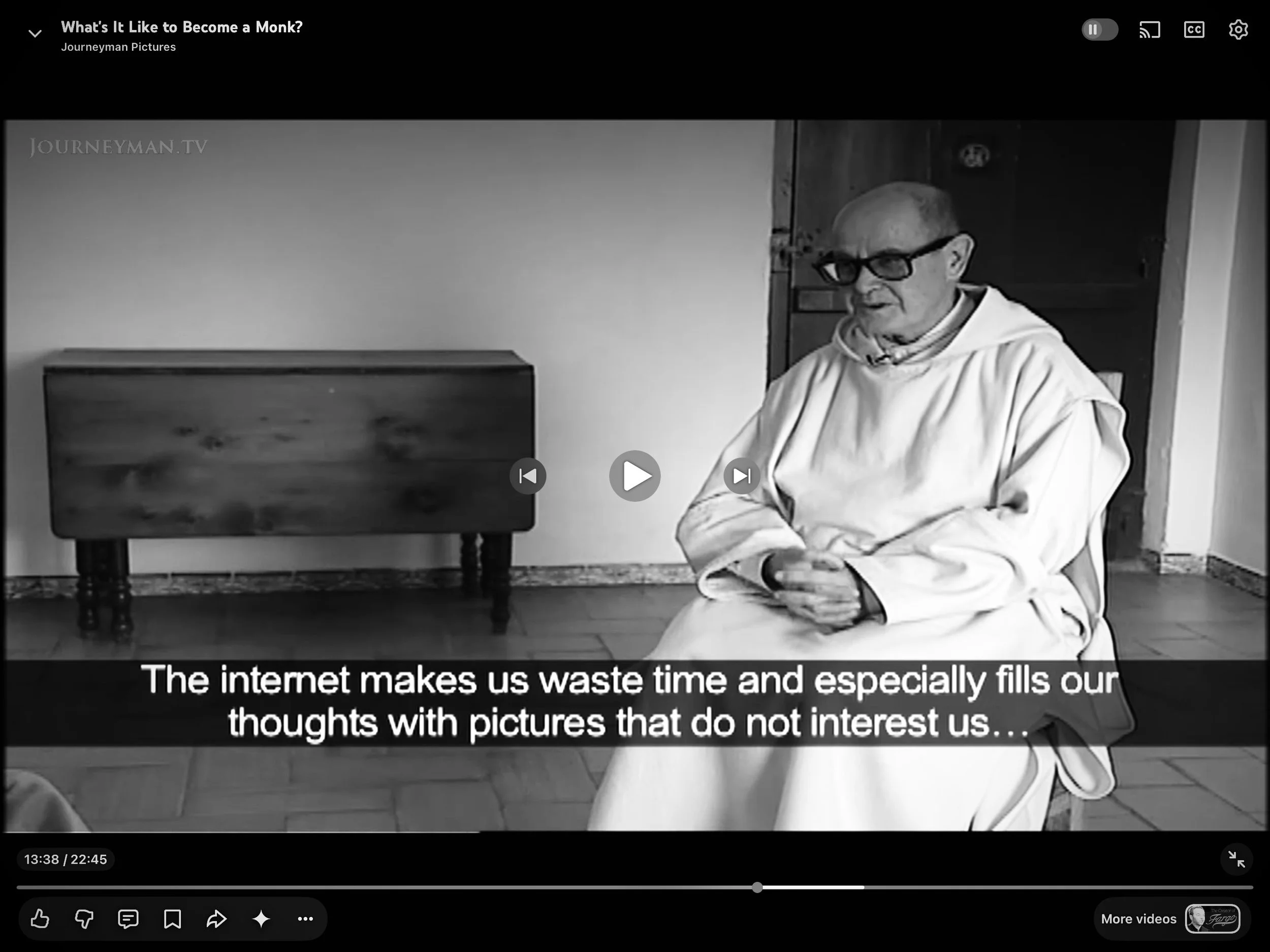
Screen shot from “What’s It Like to Become a Monk?” by Journeyman Pictures
I’ve been thinking lately about personal reinvention.
About how the modern, outside world insinuates itself into our lives. The endless notifications, breaking news, predatory algorithms, and social media feeds demanding our attention. Siphoning our emotional energy. Playing on our insecurities and weaknesses.
They succeed because our boundaries are fragile, porous, and unreinforced. They succeed because we’ve abandoned the gatehouses of our souls.
All this outside noise makes it hard to return to ourselves.
This is why I abandoned my blog on Substack. It started to feel like another social media app. Another noisy courtyard of desperados vying for attention. I felt like it was pushing me away from myself. Away from serious writing.
The day before I left Substack, I was flipping through an old personal journal. I came across this note to myself:
“Slow down. Speak less. Speak slowly. Listen more deeply. Invite silence. TV off. No social media. Less blinking screens. More books. Writing. Thoughts. Walks. Find stillness.”
When I closed the journal, I slid it next to several books about Carthusian monks on my bookshelf.
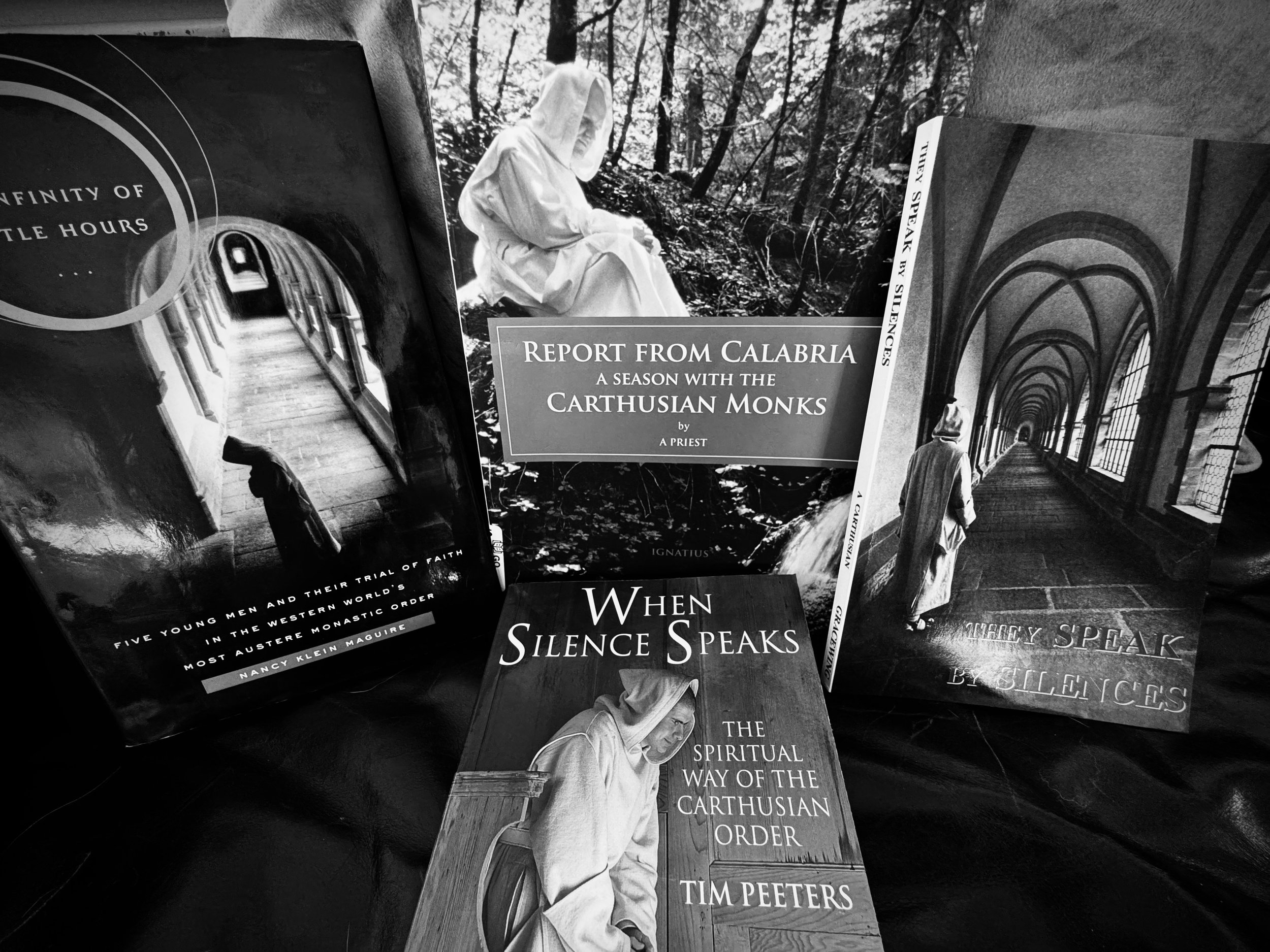
Books I own about Carthusian monks
Carthusians are the most austere, eremitic monastic order in the Catholic Church. They spend 80% of their monastic lives alone in individual cells where they pray, eat, sleep, and study.
When they die, they are buried in the earth without a coffin. Their grave markers, simple wooden crosses, bear no names or dates.
As if they never existed.
The Carthusians understand that you cannot access your deepest interiority while managing a public persona.
Carthusians reject the ego. They focus on the vertical relationship between the soul and the divine. They’ve left behind their old, civilian lives. They’ve abandoned their professional titles. They’ve rejected competition and comparison and all the tired battles we fight for love, attention, and gain.
They’ve reinvented themselves. Back into something pure and holy.
We start life that way.
Every baby I ever met was pure and holy. No false pretensions. No subterfuge. No performance. Just love and joy.
That’s what I envision when I think of reinvention. The desire to slow down and rediscover the person I used to be. The artistic soul who found joy in creativity for creativity’s sake.
My personal website is a Carthusian cell.
Free from algorithms training me to write for the crowd. A quiet place where I can rediscover my deepest thoughts and feelings and expressions. A silent sanctuary to think and write, unmolested and uninfluenced by fads and the capricious whims of society.
Maybe I’m taking myself and my writing too seriously.
But then, how many young men intent on monastic life were told, “Aren’t you taking this religious thing a little too seriously?”
There is a moment in a documentary about Carthusian monastics where an aging monk sits against a whitewashed wall, his hands folded loosely in his lap. His eyes gaze steadily behind thick-rimmed glasses at the interviewer.
The monk delivers a quiet indictment of the modern soul:
“The internet makes us waste time and especially fills our thoughts with pictures that do not interest us.”
This particular monk is the only one in the Carthusian monastery who’s allowed to use a computer for his work. It’s a standalone computer and printer, disconnected from the internet.
The interviewer alludes to online temptations and the monk says, “Everyone has temptations in this world. Even Christ had temptations.”
I used to post my writings, photography, and artwork on Facebook, Instagram, and even Substack’s Notes.
It’s nice to get feedback and comments. They make you feel like what you’re doing matters. That people are paying attention to your work.
But there’s a risk. A temptation that it becomes more about you than the work.
When we cast an eye on audience approval, we lose complete focus on the work. We dilute our authenticity and our original vision. We start playing to the crowd instead of our creative dreams.
We buy into the lie.
This was illustrated powerfully in the film Pig, in which a famous chef, Robin Feld (played by Nicolas Cage) walks away from his profession rather than selling out. In the film’s best scene, he shows up (bloodied from a recent confrontation) in a former student’s restaurant.
It’s a fancy, upscale restaurant.
The former student and now a head chef, Derek Finway (played brilliantly by David Knell) doesn’t recognize Chef Feld at first. Eventually he does and he sits down with him. An assistant brings an expensive bottle of wine. Chef Feld looks around the restaurant.
The following conversation unfolds:
Feld: “What’s the concept here?”
Derek: “We’re interested in taking local ingredients native to this region and just, deconstructing them. You know, making the familiar feel foreign. Thereby giving us an even greater appreciation of food as a whole.”
Feld: “This is the kind of cooking you like?”
Derek: “It’s cutting edge, it’s very exciting.”
Feld: “Exciting.”
Derek: “I mean, everybody loves it.”
Feld stares silently at the nervous Derek.
Feld: “You like cooking it?”
Derek swallows and says, “Absolutely.”
Feld: “Derek, what was it you always used to talk about opening? Wasn’t it a pub?”
Derek starts to babble a response, “Everybody loves it here, this is a huge success.”
Feld: “Why didn’t you open your pub?”
Derek continues to babble and finally says, “I don’t know…I really wanted…uh, it’s such a long time ago.”
Feld: “When I fired you I asked you what you wanted to do. You said you had a few rooms upstairs, a real English pub.”
Derek: “Did I? Did I say that?”
Feld: “Yes.”
Derek: “Nobody wants pubs around here, it’s just a terrible investment.”
Feld: “What was going to be your signature dish?”
Immediately, without hesitation, Derek says, “Liver scotch eggs with a honey cream mustard.” And then he starts laughing, hysterically. The kind of laughter that’s not happiness but sorrow.
Feld: “They’re not real. You get that, right? None of it’s real. The critics aren’t real. The customers aren’t real. Because this (he points at the restaurant) isn’t real. You aren’t real.”
Derek laughs nervously.
Feld: “Derek, why do you care about these people? They don’t care about you. None of them. They don’t even know you. Because you haven’t shown them. Every day you wake up and there’ll be less of you. You live your life for them and they don’t even see you. You don’t even see yourself.”
And then Feld delivers the most important line in the movie:
“We don’t get a lot of things to really care about.”
Writers have been leaving Substack lately. And university students are booing technology leaders who praise AI in their commencement speeches.
I think a lot of people long for something simpler, quieter, and closer to themselves.
People are shutting down their social media accounts. They’ve had enough of influencers and the frantic need to be witnessed. They want to slow down and rediscover the person they forgot.
Their truer selves.
I’ve been reading Ben Lerner’s short novel Transcription. The book’s narrator travels to Rhode Island to interview his ninety-year-old mentor, Thomas, who is a renowned art and technology intellectual.
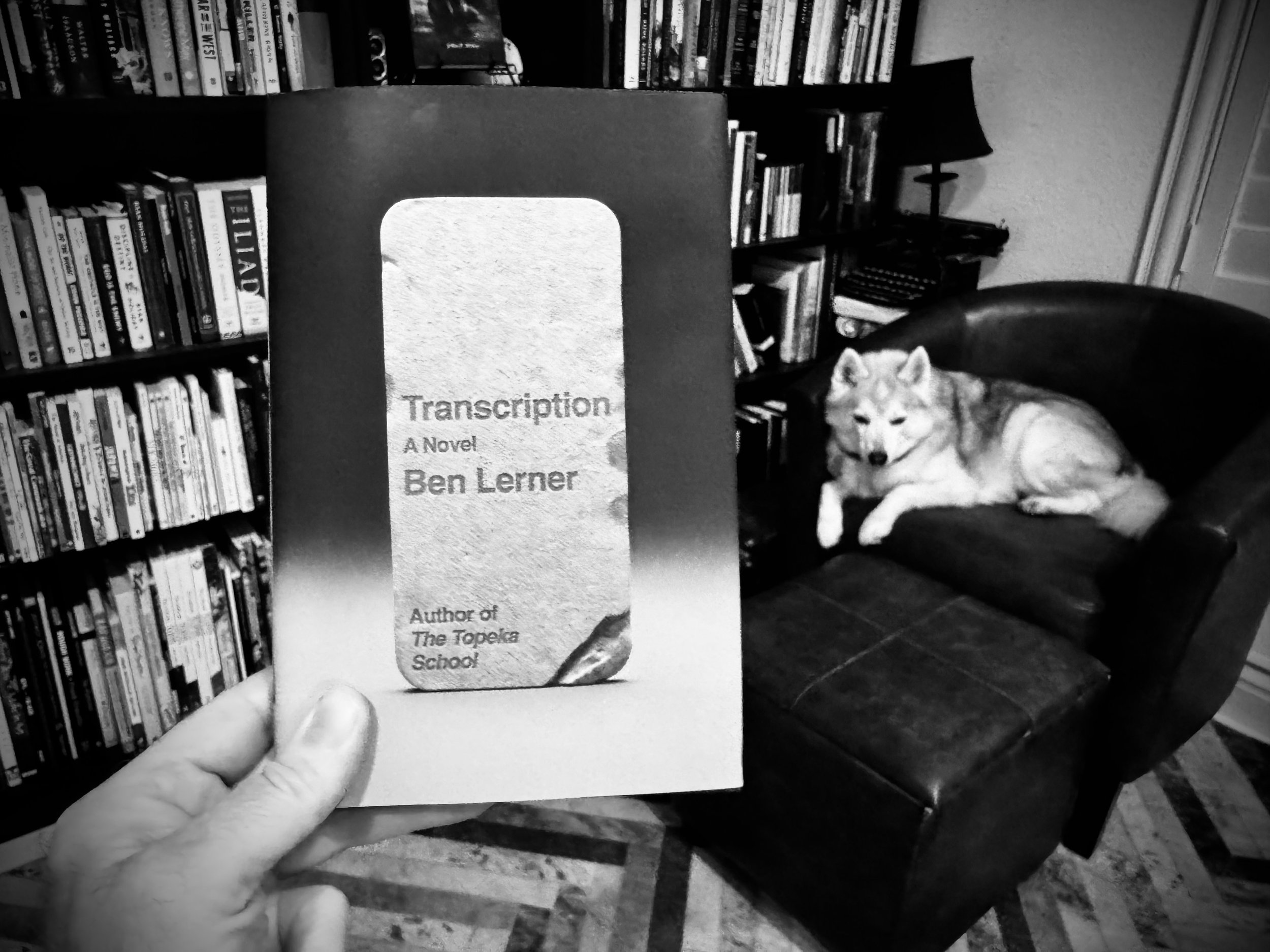
Before the interview, the narrator drops his smartphone in the hotel sink full of water. He has no way to record the interview but pretends to do so when Thomas insists there be a recording, stating, “Otherwise we repeat ourselves and it grows unnatural. We will sound like bad actors. Even the transcript will show that we have rehearsed.”
Thomas believes that a conversation only achieves its cleanest, most natural form when it is documented straight into a digital archive for posterity. He treats the presence of the recording device as the ultimate validating authority.
Thomas mirrors today’s pathological view that we are invisible until technology captures us. That an unrecorded life is an unverified life.
In contrast we have the Carthusians who reject today’s technological superficiality, empty artifice, and egocentric obsession with digital capture. They understand that fragmented minds make us strangers to ourselves, and to God.
To stay true to ourselves, we don’t have to become Carthusian monks. But maybe we can retreat inside the walls of our own invisible monastery, closing the heavy doors of the gatehouse against the outside world of digital noise, AI slop, and performative shallowness.
Doing so will help us slow down and find the person we forgot. Our truer, more honest, happier selves.
Life is short. We don’t get a lot of things to really care about. We need to choose wisely.
For myself and for my writing, this is where authenticity is reborn. Not by shouting into the algorithmic abyss, but by remaining inside the quiet, defending the slow, sacred stillness.
Because that’s where our truest selves have been waiting all along.