All They Can Do Is Stare Blankly
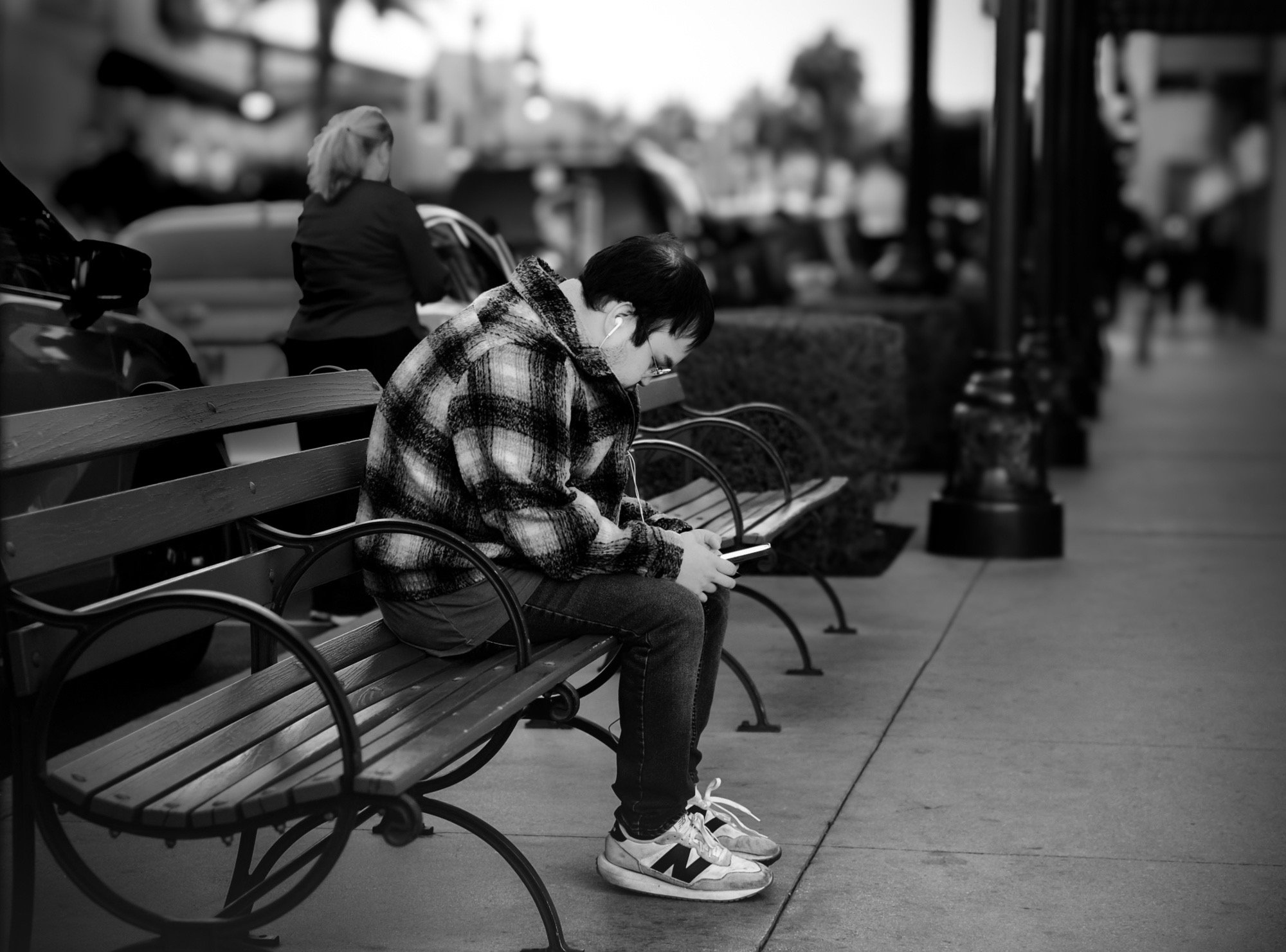
Photo by John Patrick Weiss
I saw a guy the other day seated alone on a bench in an outdoor shopping center known as Town Center. He was glued to his phone, hunched over, wearing earbuds, and playing some kind of game.
I had come to the center to take a photowalk with my rangefinder-style camera, and immediately noticed the young fellow on the bench. But I strolled past him, deciding to explore further around the center.
An hour or so later I returned, and the guy was still there, all by himself.
At one point he looked up from his phone, removed his glasses, and wiped his eyes with the sleeve of his jacket. Then he blew his nose into a tissue.
Had he been crying?
It looked that way, but I couldn’t say for sure. He slid his glasses back on and stared blankly at his phone. People walked by, oblivious to him as they went about their day.
I raised my camera and snapped a photo.
There was something profoundly sad about this young man sitting alone in the busy outdoor shopping mall. He seemed consumed with something. Loss? Grief? Despair?
F. Scott Fitzgerald comes to mind:
“The loneliest moment in someone’s life is when they are watching their whole world fall apart, and all they can do is stare blankly.”
Some of the best street photography captures candid moments when people are unposed and in the moment. Sometimes I’ll approach a person or group and tell them I’m a street photographer, and then ask if I can take their photo.
Other times, if a moment is fleeting or I don’t want to intrude, I’ll snap the photo discretely. Afterward, I may or may not share the photo with the person.
On this day, I thought I’d do the latter. I figured he might enjoy a moment of company. A brief chat. I’d show him the photo, offer to email it to him.
But first, I walked back to the car to swap out my dying camera battery.
My mind drifted backward to another soul I used to encounter who wrestled not with digital isolation but something much darker.
A trail of crumbs would follow her
There was an old woman who lived alone in a dilapidated house beside a deep gulch on the periphery of town where I worked as a policeman. She was a hoarder of epic proportions, and neighbors down the road sometimes called authorities to report a foul stench.
She drove an old truck, its bed filled with junk and rotting food and rodent droppings. Her ragged dress and tattered jacket were always soiled with dirt and grime, and her unlaced work boots were consistently caked in mud.
To watch her amble into the post office was a sight.
The poor woman’s odiferous presence would literally drive people out of the waiting line. She’d fumble a piece of tinfoil out of her pocket, peeling back the edges to reveal some dark, crumbling snack to nibble on. A trail of crumbs would follow her.
But the saddest thing was when our police department would get angry phone calls from neighbors, demanding that we respond and do something about “that woman and her filthy property.” And so we’d drive out to visit with the old woman whose husband died years back.
Her name was Elizabeth.
Anything to survive
As a young patrolman who’d grown up in an upper-middle class family, encounters with people on the margins of society were an indelible education.
Civilians keep their distance for the most part. They won’t get too close to the unhoused man on the street. One never knows what is bubbling below the surface, what demons may manifest in a sudden moment of delusional outburst or worse, an eruption to violence.
But cops are paid to respond and engage.
Cops are expected to step in when concerned parties phone 9–1–1. “He’s acting crazy,” they might say. “She doesn’t look right, I’m worried about her,” someone might report. “Get this bum off my business entrance, he’s scaring away customers,” another might complain. For Elizabeth the usual refrain from concerned citizens was, “She really smells. Can you do something?”
And we did try to do something.
We got the county involved and worked with a social worker and an attorney to stabilize her living situation. It wasn’t perfect but she did better with bathing and cleaning her clothes. The hoarding, sadly, continued.
Elizabeth was gentle, at least with me.
Whenever I’d visit, she’d often reach over and hold my forearm gently as her cloudy eyes fastened on mine and she’d recount whatever memory or recent challenge came to mind. In the winter months when she was all bundled up in her coat, scarf, and knitted cap, she looked like one of those old Russian women you see in charity TV commercials to feed the hungry.
I became less sympathetic with Elizabeth’s impatient neighbors when one of my sergeants shared Elizabeth’s remarkable backstory.
“You know she survived the war,” my sergeant said. “The Holocaust. She was in the camps. Can you imagine?”
It explained some things. I imagined that after surviving Nazi concentration camps, you might have a hard time throwing anything away.
I can’t remember if Elizabeth had pets, but I don’t think so. She lived in her deteriorating home for several years after her husband died. They were not good years. We started coming out more frequently toward the end.
I remember one afternoon she was holding my wrist as if I was some kind of human life raft. She wouldn’t let me go. Kept telling me about little things she’d done that day. Picked up this, moved that, couldn’t get the truck to start.
There was a look in those cloudy eyes of hers.
It was loneliness.
Everyone carries divinity in them
To Elizabeth’s credit, despite the terrible struggles and losses in her past, she still chose life.
Some live mostly charmed lives. Others rarely see the light. Much depends on where we’re born, who raises us, and the circumstances into which we’re born.
Some of us simply carry heavier burdens than others.
Who knows what demons and ugly memories haunted Elizabeth’s being? Yet despite her hoarding and personal struggles, she found moments to smile, giggle, and offer a bit of food (which I’d accept so as not to offend, but admit tossing out later because one could never know how stale or tainted it was).
Years ago I read Richard Paul Evans’ book The Walk. In it, a kind and wise waitress spoke about meeting dead people every day at the diner. People who had given up on life. She talked about how growth requires pain, and thus to choose life is to accept pain.
The waitress believed that everyone carries divinity in them. And the way we save ourselves is by helping others.
In my policing career I met many sad souls who’d given up on life and retreated into their bottles, drugs, criminality, and broken lives. We’d try our best to help. We gave them professional referrals. We donated food, blankets, and bus money.
Sometimes an arrest was the only thing between them and oblivion. A respite at county jail where they’d get fed, cleaned up, sober, and maybe into a program. Other times, the arrest made things worse. They’d meet dark hearts in jail. Make plans. Commit new crimes. Sink deeper into despair.
At least Elizabeth wasn’t one of the dead people.
She may have been wounded, haunted, and irreparably altered by life’s slings and arrows. But she accepted the pain. She lived with it every day. Even when her neighbors called the police on her.
She still chose life.
At least I’ll do my part
I reached my car outside the Town Center and rifled through the glove box for my spare Fuji camera battery. I popped out the dead battery, inserted the fresh one, and clicked on the power switch. Reviewing the image of that lonely chap on the LCD screen, I smiled. Not bad.
Making my way back to the plaza, I thought about Elizabeth and the many other lonely souls I’d met in my law enforcement career. The people walking around with extinguished spirits.
I thought of the ones who slipped through the cracks, and the ones we were able to save.
I glanced down one last time at the digital image of the young man. At least I’ll do my part, I thought. I’ll say hello. Show him the photo. Maybe cheer up his day.
But when I rounded the corner, the bench was empty.